AP EAPCET 2018 (23rd April Shift 1) Chemistry: General Organic Chemistry

Multiple choice, one correct option AP EAPCET paper General Organic Chemistry

Which of the following represents the hyperconjugation effect?
(see the figure above)
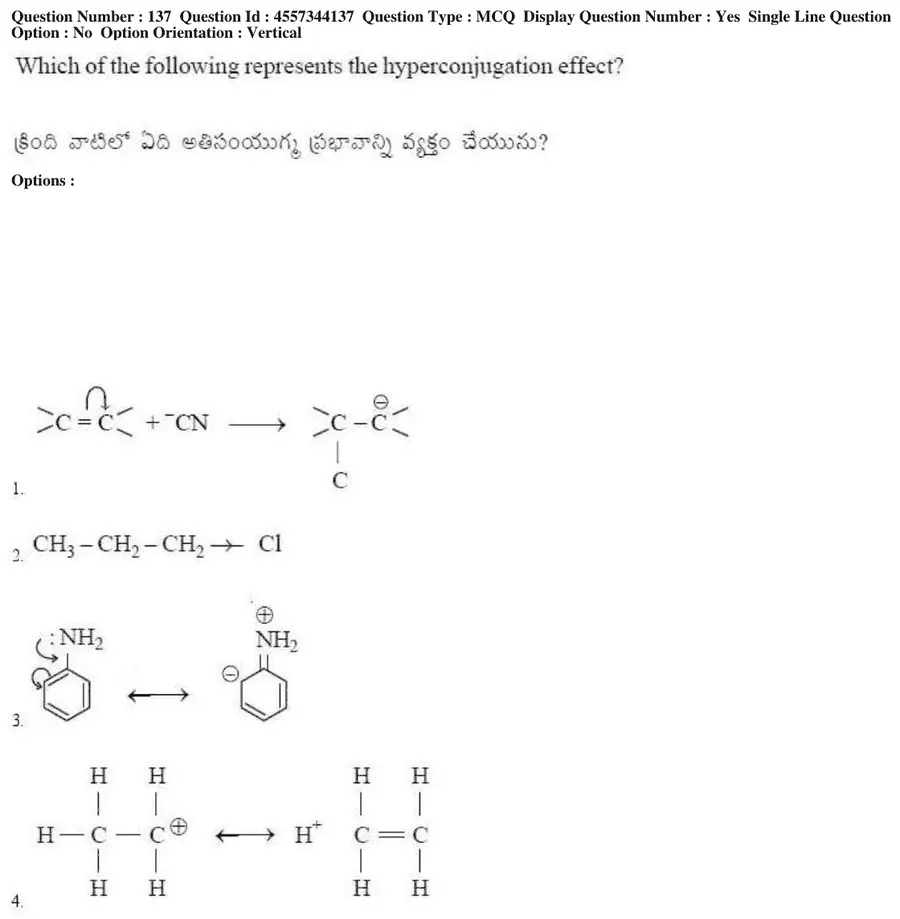
The question and its figure as printed in AP EAPCET 2018 23rd April Shift 1. Option 1: curved arrow from the C=C double bond: >C=C< + ^-CN → >C(CN)-C^-< (nucleophile addition to alkene giving a carbanion) Option 2: CH3-CH2-CH2 → Cl (arrow towards Cl) Option 3: aniline resonance: :NH2 on benzene with curved arrows ^+NH2 (double bond to ring) with negative charge on the ring Option 4: CH3-CH2^+ (H-C(H)(H)-C(H)(H) with + on the second carbon) H^+ + CH2=CH2
The question as printed in the paper.
  1. (1)

    see figure curved arrow from the C=C double bond: $>C=C< + {}^{-}CN \rightarrow >C(CN)-C^{-}<$ (nucleophile addition to alkene giving a carbanion)

  2. (2)

    see figure $\mathrm{CH_3-CH_2-CH_2 \rightarrow Cl}$ (arrow towards Cl)

  3. (3)

    see figure aniline resonance: $\mathrm{{:}NH_2}$ on benzene with curved arrows $\longleftrightarrow$ $\mathrm{{}^{+}NH_2}$ (double bond to ring) with negative charge on the ring

  4. (4)

    see figure $\mathrm{CH_3-CH_2^{+}}$ (H-C(H)(H)-C(H)(H) with + on the second carbon) $\longleftrightarrow$ $\mathrm{H^{+}}$ + $\mathrm{CH_2=CH_2}$

Show answer

Option (4) is correct.

The council's preliminary key

See the step-by-step solution in EdLoop

The worked solution is in the EdLoop app, free on Android, with every other General Organic Chemistry question from 2010 to 2026.

Chemistry General Organic Chemistry question from AP EAPCET 2018 (23rd April Shift 1) (AP EAPCET exam). This is the paper as APSCHE held it.

All EAPCET General Organic Chemistry PYQs (185 questions)