AP EAPCET 2020 (17th Sep 2020 Shift1) Physics: Waves

Multiple choice, one correct option AP EAPCET paper Waves

A plane wave $y = a\sin(\omega t - kx)$ propagates through a stretched string. The particle velocity versus $x$ graph at $t = 0$ is
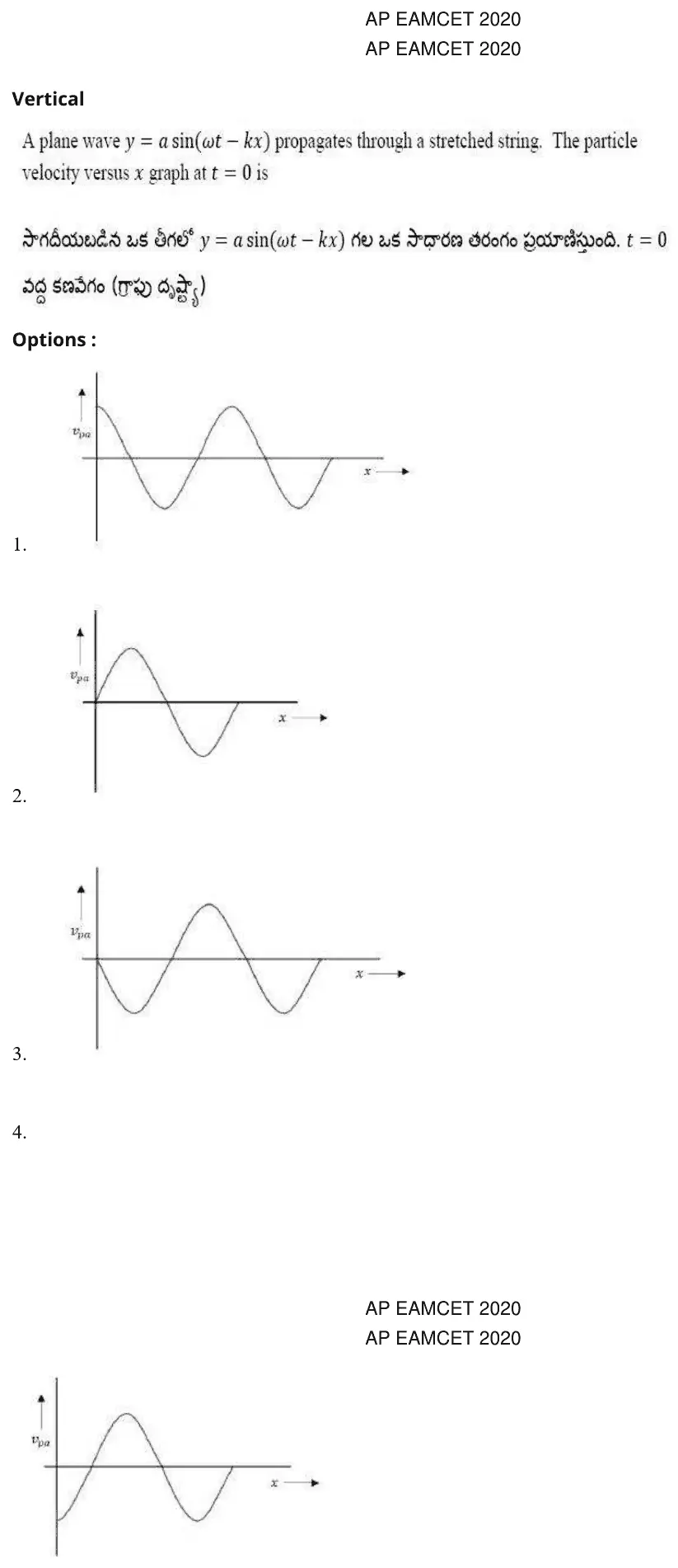
The question and its figure as printed in AP EAPCET 2020 17th Sep 2020 Shift1. Option 1: cosine-shaped curve starting at a positive value (near maximum) at x=0, falling through zero to a minimum, back up to a maximum, down again (about 1.5 cycles) Option 2: sine-shaped curve starting at zero, rising to a maximum, falling through zero to a minimum, then back up to zero (one cycle) Option 3: negative-sine-shaped curve starting at zero, dipping to a minimum first, rising to a maximum, then down to a second minimum (about 1.5 cycles) Option 4: curve starting at a negative value (slightly above its minimum, below the axis) at x=0, rising through zero to a maximum, falling through zero to a…
The question as printed in the paper.
  1. (1)

    see figure cosine-shaped curve starting at a positive value (near maximum) at x=0, falling through zero to a minimum, back up to a maximum, down again (about 1.5 cycles)

  2. (2)

    see figure sine-shaped curve starting at zero, rising to a maximum, falling through zero to a minimum, then back up to zero (one cycle)

  3. (3)

    see figure negative-sine-shaped curve starting at zero, dipping to a minimum first, rising to a maximum, then down to a second minimum (about 1.5 cycles)

  4. (4)

    see figure curve starting at a negative value (slightly above its minimum, below the axis) at x=0, rising through zero to a maximum, falling through zero to a minimum and ending near the axis (about 1 cycle)

Show answer

Option (1) is correct.

The council's preliminary key

See the step-by-step solution in EdLoop

The worked solution is in the EdLoop app, free on Android, with every other Waves question from 2010 to 2026.

Physics Waves question from AP EAPCET 2020 (17th Sep 2020 Shift1) (AP EAPCET exam). This is the paper as APSCHE held it.

All EAPCET Waves PYQs (206 questions)