AP EAPCET 2023 (17th May 2023 Shift 2) Chemistry: Polymers

Multiple choice, one correct option AP EAPCET paper Polymers

Which of the polymer is used in the controlled release of drug?
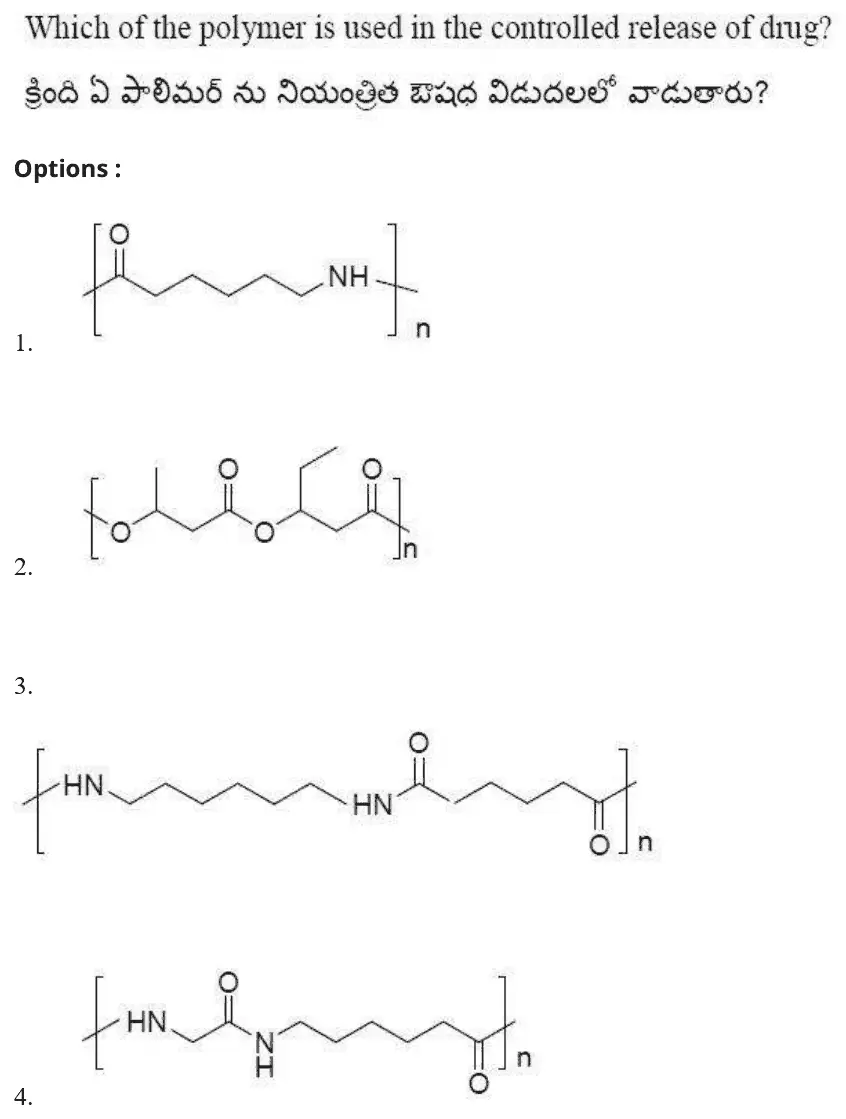
The question and its figure as printed in AP EAPCET 2023 17th May 2023 Shift 2. Option 1: Polymer repeat unit in brackets with subscript n: a C=O (carbonyl, O at top) at the left end of a zigzag chain of carbons, ending on the right in an NH group bonded to the bracket (polycaprolactam, Nylon-6 type). Option 2: Polyester repeat unit in brackets with subscript n: bracket bond at left to O, then a branched carbon (methyl) chain, then a C=O (carbonyl O at top), then O, then a CH-CH2 chain with an ethyl branch and a terminal C=O (carbonyl O at top) at the right bracket (a copolyester of 3-hydroxybutanoic acid and 3-hydroxypentanoic acid, PHBV type). Option 3: Polyamide repeat unit in brackets…
The question as printed in the paper.
  1. (1)

    see figure Polymer repeat unit in brackets with subscript n: a C=O (carbonyl, O at top) at the left end of a zigzag chain of carbons, ending on the right in an NH group bonded to the bracket (polycaprolactam, Nylon-6 type).

  2. (2)

    see figure Polyester repeat unit in brackets with subscript n: bracket bond at left to O, then a branched carbon (methyl) chain, then a C=O (carbonyl O at top), then O, then a CH-CH2 chain with an ethyl branch and a terminal C=O (carbonyl O at top) at the right bracket (a copolyester of 3-hydroxybutanoic acid and 3-hydroxypentanoic acid, PHBV type).

  3. (3)

    see figure Polyamide repeat unit in brackets with subscript n: HN at left, a long zigzag carbon chain, HN, then a C=O (carbonyl O at top), a zigzag carbon chain, then a terminal C=O (carbonyl O at bottom) at the right bracket (Nylon-6,6 type).

  4. (4)

    see figure Polyamide repeat unit in brackets with subscript n: HN at left, then C=O (carbonyl O at top), then N-H (drawn with N and H stacked vertically), a zigzag carbon chain, then a terminal C=O (carbonyl O at bottom) at the right bracket.

Show answer

Option (2) is correct.

The council's preliminary key

See the step-by-step solution in EdLoop

The worked solution is in the EdLoop app, free on Android, with every other Polymers question from 2010 to 2026.

Chemistry Polymers question from AP EAPCET 2023 (17th May 2023 Shift 2) (AP EAPCET exam). This is the paper as APSCHE held it.

All EAPCET Polymers PYQs (115 questions)