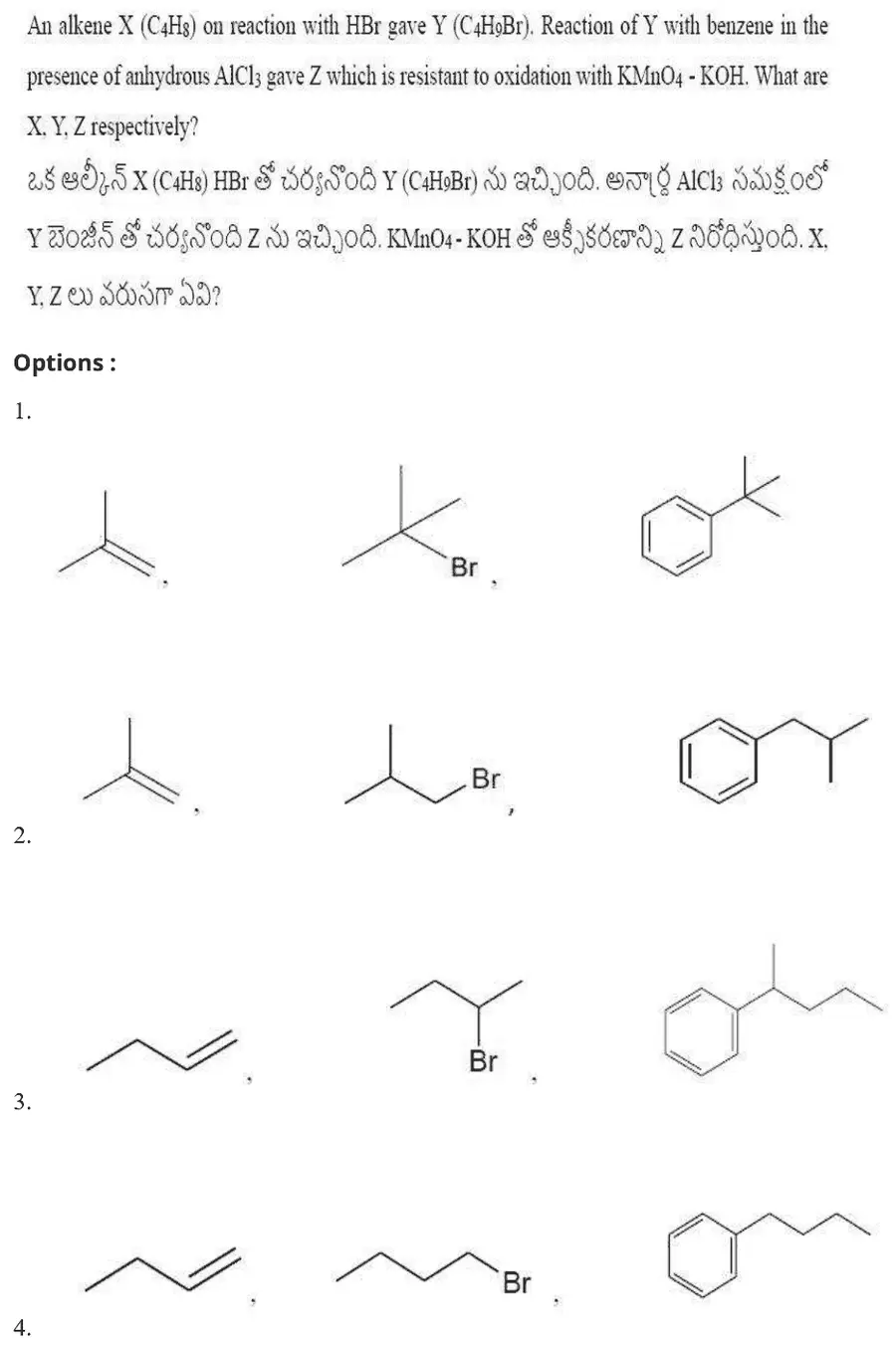
An alkene X ($\mathrm{C_4H_8}$) on reaction with HBr gave Y ($\mathrm{C_4H_9Br}$). Reaction of Y with benzene in the presence of anhydrous $\mathrm{AlCl_3}$ gave Z which is resistant to oxidation with $\mathrm{KMnO_4}$ - KOH. What are X, Y, Z respectively?
- (1)
see figure X: isobutylene (2-methylprop-1-ene) skeletal structure; Y: tert-butyl bromide (2-bromo-2-methylpropane); Z: tert-butylbenzene
- (2)
see figure X: isobutylene (2-methylprop-1-ene) skeletal structure; Y: isobutyl bromide (1-bromo-2-methylpropane); Z: isobutylbenzene
- (3)
see figure X: but-1-ene; Y: 2-bromobutane (sec-butyl bromide); Z: sec-butylbenzene
- (4)
see figure X: but-1-ene; Y: 1-bromobutane (n-butyl bromide); Z: n-butylbenzene
Show answer
Option (1) is correct.
The council's preliminary key