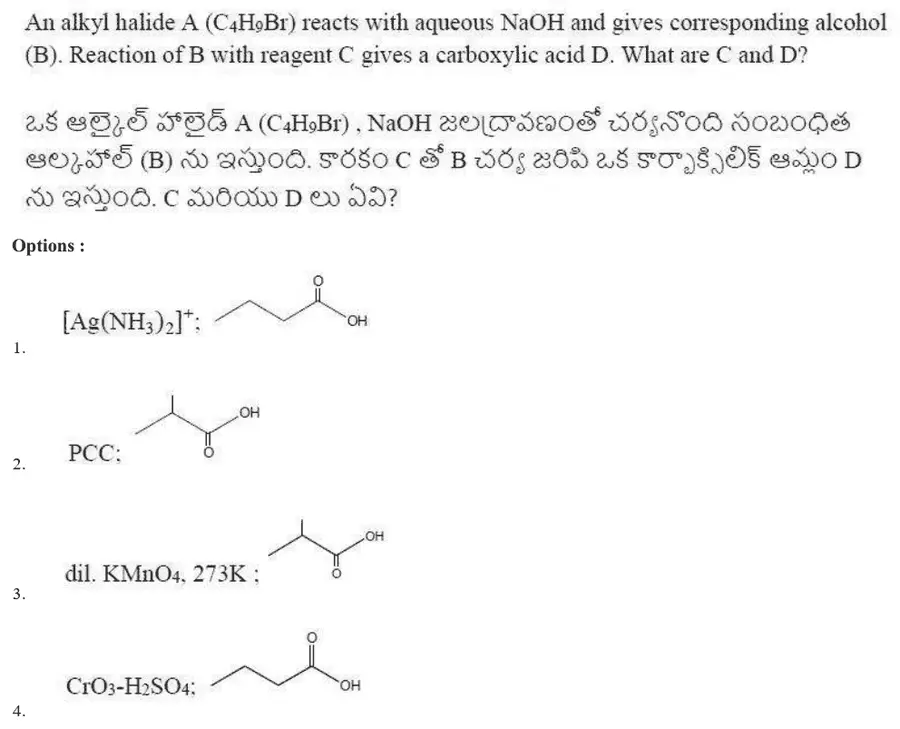
An alkyl halide A ($\mathrm{C_4H_9Br}$) reacts with aqueous NaOH and gives corresponding alcohol (B). Reaction of B with reagent C gives a carboxylic acid D. What are C and D?
- (1)
$\mathrm{[Ag(NH_3)_2]^+}$; (see the figure above) skeletal structure of butanoic acid (straight chain CH3CH2CH2COOH)
- (2)
PCC; (see the figure above) skeletal structure of 3-methylpropanoic... i.e. isobutyric-type acid: branched chain with a methyl branch on the carbon next to the COOH-bearing chain, ending in C(=O)OH
- (3)
dil. $\mathrm{KMnO_4}$, 273K ; (see the figure above) skeletal structure of a branched carboxylic acid with a methyl branch (same as option 2), ending in C(=O)OH
- (4)
$\mathrm{CrO_3}$-$\mathrm{H_2SO_4}$; (see the figure above) skeletal structure of butanoic acid (straight chain, ending in C(=O)OH)
Show answer
Option (4) is correct.
The council's preliminary key