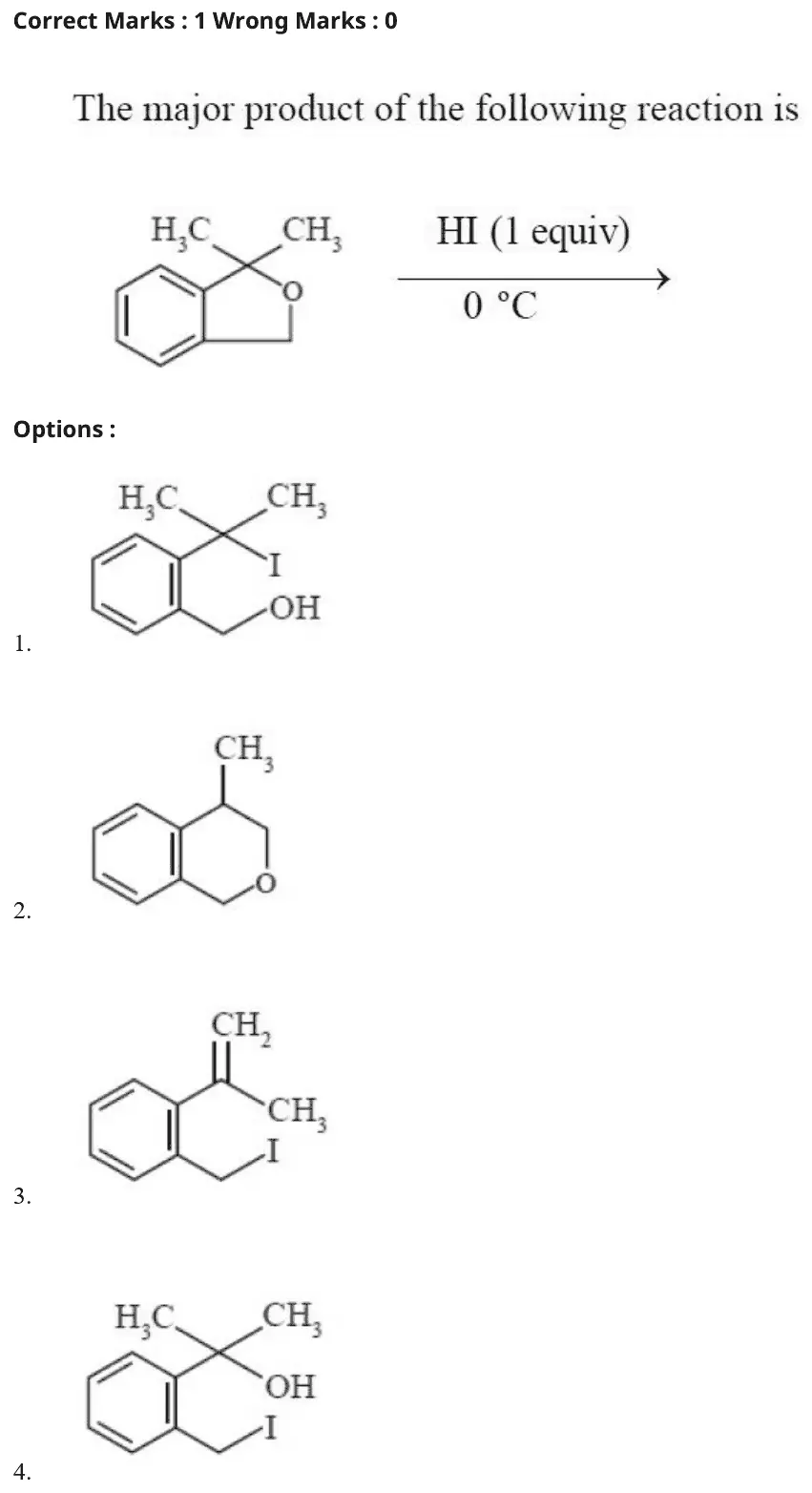
The major product of the following reaction is (see the figure above)
The question as printed in the paper.
(1)
see figure benzene ring fused to a chain: ring carbon bearing $\mathrm{H_3C}$, $\mathrm{CH_3}$ and I (tertiary C(CH3)2-I), and the neighbouring ring substituent $\mathrm{CH_2OH}$
(2)
see figure benzene ring fused to a six-membered ring containing O, with a $\mathrm{CH_3}$ on the carbon next to the ring carbon (ring ether)
(3)
see figure benzene ring with $\mathrm{C(=CH_2)CH_3}$ on one ring carbon and $\mathrm{CH_2I}$ on the adjacent carbon
(4)
see figure benzene ring with $\mathrm{C(CH_3)_2OH}$ ($\mathrm{H_3C}$, $\mathrm{CH_3}$, OH) on one ring carbon and $\mathrm{CH_2I}$ on the adjacent carbon
Show answer
Option (1) is correct.
The council's preliminary key
See the step-by-step solution in EdLoop
The worked solution is in the EdLoop app, free on Android, with every other Alcohols, Phenols & Ethers question from 2010 to 2026.