The major products P and Q formed in the following reactions schemes are
(A) benzene $+\ \mathrm{CH_{3}CH_{2}CH_{2}Cl}\xrightarrow{\mathrm{AlCl_{3}\ (anhyd.)}}$ P
(B) benzene $\xrightarrow[\substack{\text{ii) }\mathrm{Br_{2},\,h\upsilon}\\\text{iii) aq. KOH}}]{\text{i) }\mathrm{CH_{3}Cl/AlCl_{3}\ (anhyd.)}}$ Q
(see the figure above)
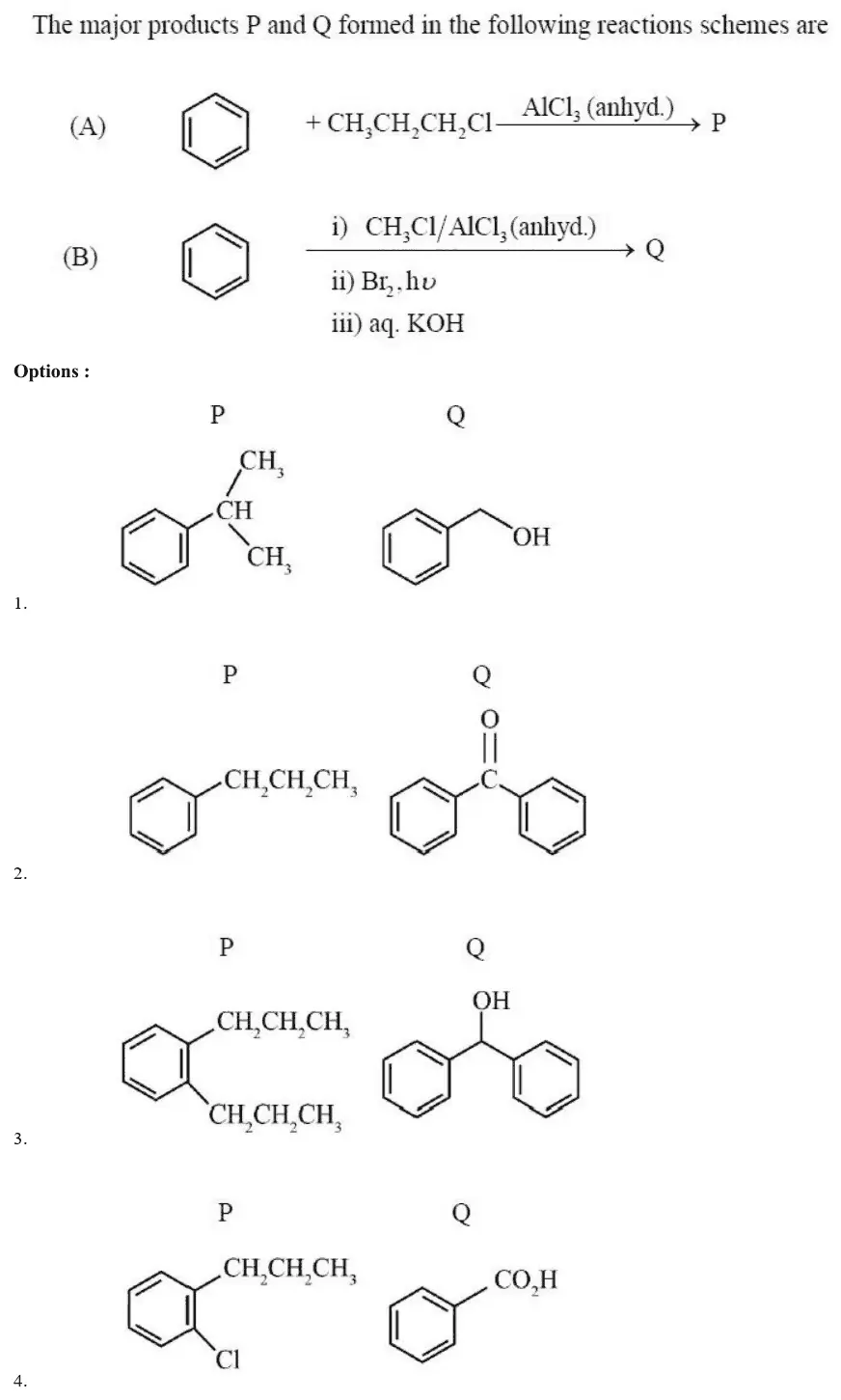
- (1)
P: isopropylbenzene (benzene ring bearing a CH(CH3)2 group); Q: benzyl alcohol (benzene ring bearing CH2-OH)
- (2)
P: n-propylbenzene (benzene ring bearing CH2CH2CH3); Q: benzophenone (two benzene rings joined through C=O)
- (3)
P: 1,2-di-n-propylbenzene (benzene ring bearing two adjacent CH2CH2CH3 groups); Q: diphenylmethanol (two benzene rings on a CH-OH carbon)
- (4)
P: 1-chloro-2-n-propylbenzene (ring bearing CH2CH2CH3 and an adjacent Cl); Q: benzoic acid (benzene ring bearing CO2H)
Show answer
Option (1) is correct.
The council's preliminary key