An alcohol X ($\mathrm{C_5H_{12}O}$) produces turbidity instantly with conc. $\mathrm{HCl/ZnCl_2}$. Isomer (Y) of X undergoes dehydration with conc. $\mathrm{H_2SO_4}$ at 443 K. X and Y respectively are
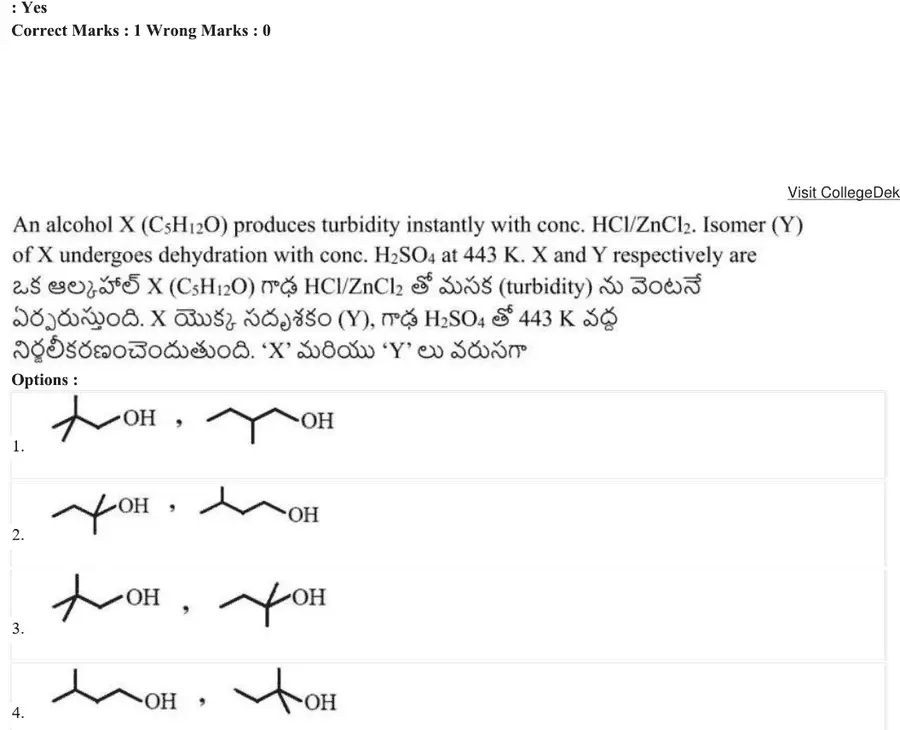
- (1)
see figure Two skeletal structures separated by a comma: first is 2,2-dimethylpropan-1-ol (neopentyl alcohol, a quaternary carbon bearing three methyls with CH2OH); second is 4-methylbutan-2-ol type structure drawn as a zigzag with a branch at the centre and OH at the right end (3-methylbutan-1-ol/isopentyl-like skeleton).
- (2)
see figure Two skeletal structures separated by a comma: first is a tertiary alcohol (2-methylbutan-2-ol, with C bearing OH and a methyl branch drawn downward); second is a zigzag chain with a branch and OH at the right end (pentan-2-ol/3-methylbutan-1-ol type).
- (3)
see figure Two skeletal structures separated by a comma: first is 2,2-dimethylpropan-1-ol type (quaternary carbon with CH2OH); second is a tertiary alcohol (2-methylbutan-2-ol) with OH on a carbon bearing a downward methyl.
- (4)
see figure Two skeletal structures separated by a comma: first is a branched primary alcohol (3-methylbutan-1-ol, zigzag with a branch on top and OH at the right end); second is a tertiary alcohol (2-methylbutan-2-ol) with OH on a carbon bearing a downward methyl.
Show answer
Option (2) is correct.
The council's preliminary key