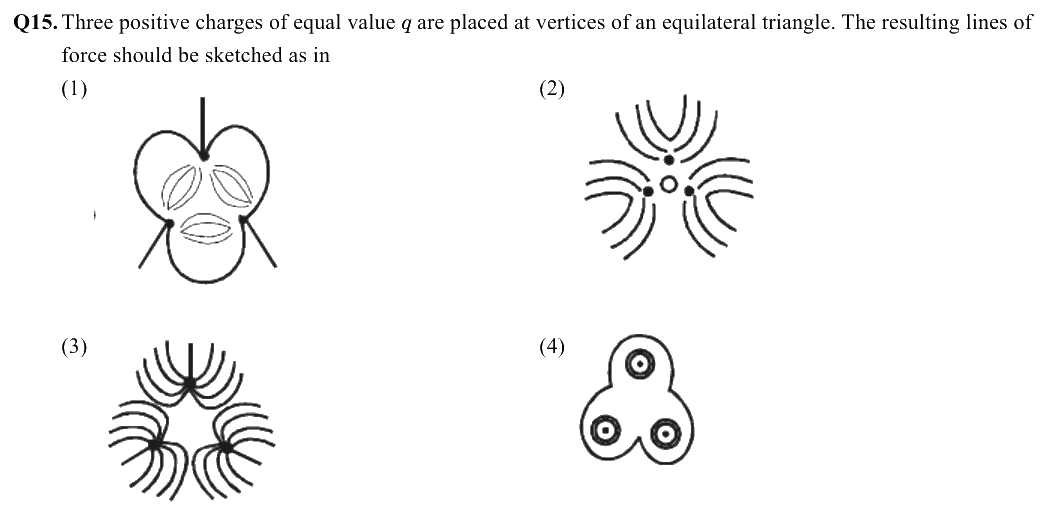
Three positive charges of equal value $q$ are placed at vertices of an equilateral triangle. The resulting lines of force should be sketched as in
- (1)
see figure Three charges at the vertices of a triangle (one dot at the top, two at the lower left and lower right) are enclosed by a single closed outline shaped like a three-lobed clover that wraps around all three; straight lines run outwards from each of the three dots, away from the figure (one upward from the top charge, one down-left and one down-right from the lower charges). Inside the outline, between the charges, there are small lens-shaped pairs of curved lines: one between top and lower-left, one between top and lower-right and one between the two lower charges.
- (2)
see figure Three dots at the vertices of a small triangle (one at top, two lower left and right) with a small open circle at the centre of the triangle. Curved field lines leave from the region of each dot and bend away outwards, in three fans pointing up, to the lower left and to the lower right; the lines of neighbouring charges do not meet but curve apart, leaving gaps between the three fans.
- (3)
see figure Three dots at the vertices of a large triangle (one at top, two at lower left and right). From each dot a fan of many curved lines spreads outwards, bending away from the neighbouring charges; the three fans are separate and no lines join one charge to another.
- (4)
see figure Three small concentric-ring symbols (a dot inside two circles) at the vertices of a triangle (one at top, two at lower left and right), each ringed by closed loops, with a single closed outline round all three giving a three-lobed shape (like a clover) with indentations between the lobes.
Show answer
Option (3) is correct.
Key from source paper