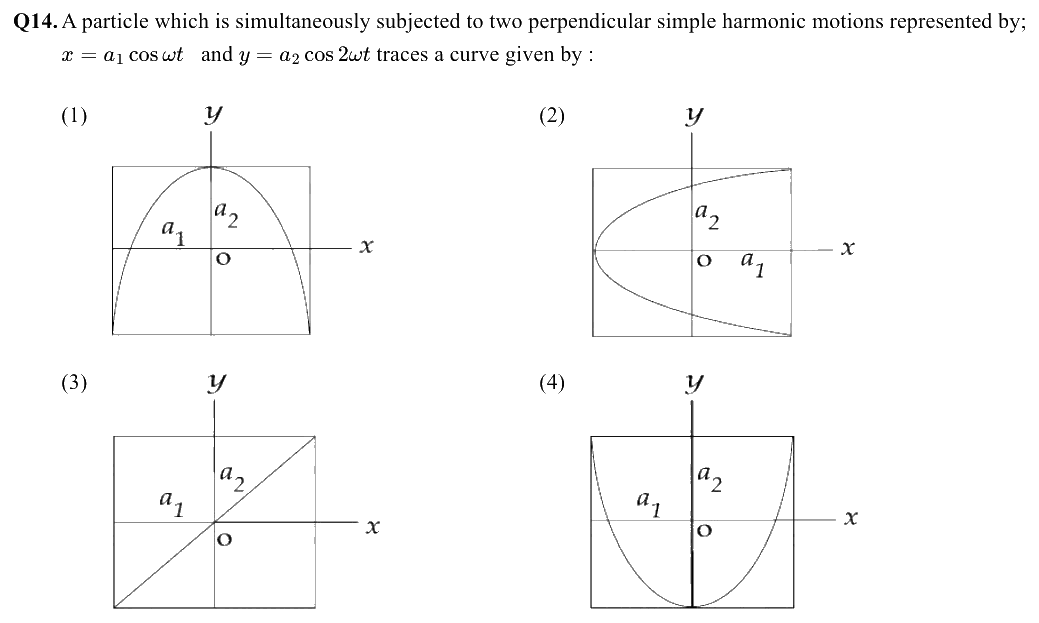
A particle which is simultaneously subjected to two perpendicular simple harmonic motions represented by; $x = a_1\cos\omega t$ and $y = a_2\cos 2\omega t$ traces a curve given by :
- (1)
see figure Curve in the x-y plane inside a rectangular box centred on the origin O (box half-width a_1, half-height a_2, labels a_1 on the x side and a_2 on the y side). The curve is a downward parabola: it starts at the bottom-left corner (-a_1, -a_2), rises to a peak on the top edge of the box at x = 0 (on the y-axis, y = a_2) and falls to the bottom-right corner (+a_1, -a_2); it fills the box and is symmetric about the y-axis.
- (2)
see figure Same kind of box with axes, O, a_1 and a_2. The curve is a sideways parabola with its vertex on the x-axis at the left edge (x = -a_1, y = 0), opening to the right and reaching the right edge of the box at the top (y = +a_2) and bottom (y = -a_2); it is symmetric about the x-axis.
- (3)
see figure Same kind of box with axes, O, a_1 and a_2. The curve is a straight diagonal line through O from the bottom-left corner (-a_1, -a_2) to the top-right corner (+a_1, +a_2).
- (4)
see figure Same kind of box with axes, O, a_1 and a_2. The curve is an upright parabola with its vertex at the bottom edge on the y-axis (x = 0, y = -a_2), opening upward and reaching the top-left and top-right corners (-a_1, +a_2) and (+a_1, +a_2); it is symmetric about the y-axis.
Show answer
Option (4) is correct.
Key from source paper