A small ball of mass $\mathrm{m}$ starts at a point A with speed $\mathrm{v_o}$ and moves along a frictionless track AB as shown. The track BC has coefficient of friction $\mu$. The ball comes to stop at C after travelling a distance $L$ which is:
(see the figure above)
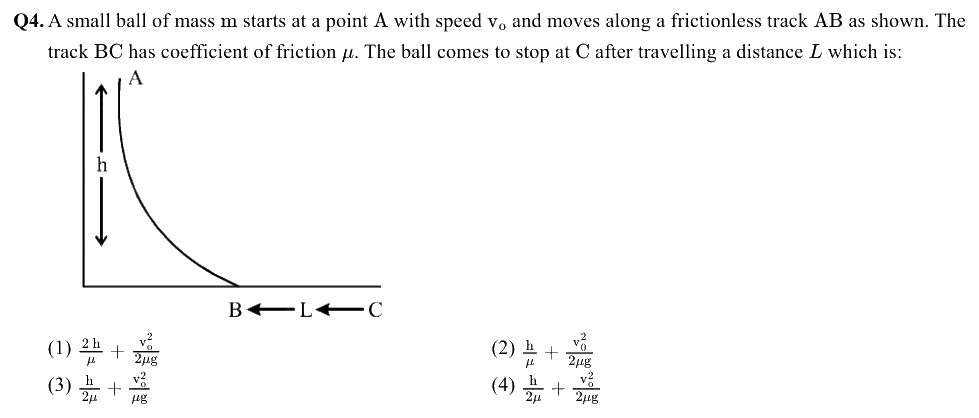
- (1)
$\frac{2\mathrm{h}}{\mu} + \frac{\mathrm{v_o^2}}{2\mu\mathrm{g}}$
- (2)
$\frac{\mathrm{h}}{\mu} + \frac{\mathrm{v_o^2}}{2\mu\mathrm{g}}$
- (3)
$\frac{\mathrm{h}}{2\mu} + \frac{\mathrm{v_o^2}}{\mu\mathrm{g}}$
- (4)
$\frac{\mathrm{h}}{2\mu} + \frac{\mathrm{v_o^2}}{2\mu\mathrm{g}}$
Show answer
Option (2) is correct.
Key from source paper