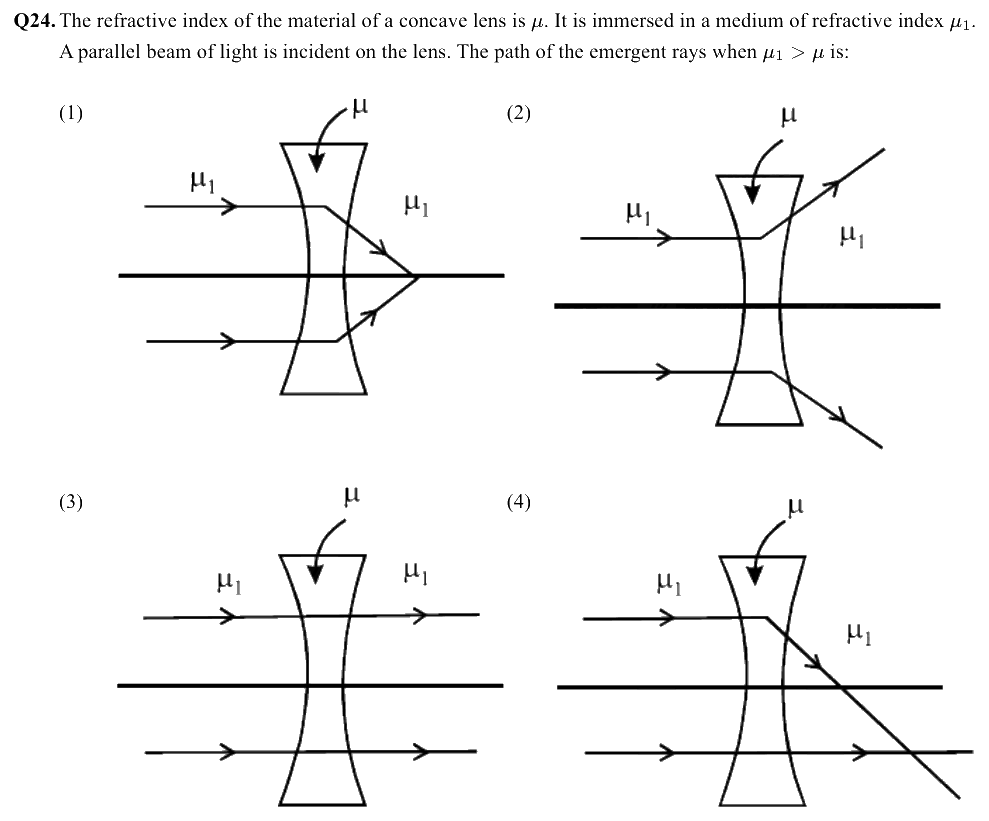
The refractive index of the material of a concave lens is $\mu$. It is immersed in a medium of refractive index $\mu_1$. A parallel beam of light is incident on the lens. The path of the emergent rays when $\mu_1 > \mu$ is:
- (1)
see figure Concave (biconcave) lens labelled mu (curved arrow pointing at the lens), surrounding medium labelled mu1 on both sides. Two parallel rays come from the left (arrows pointing right), one above and one below the principal axis. After the lens both rays bend towards the axis (converge) and meet at a single point on the axis to the right of the lens.
- (2)
see figure Same lens and labels. The two parallel rays from the left bend away from the axis after the lens: the upper ray goes up and to the right, the lower ray goes down and to the right (diverging).
- (3)
see figure Same lens and labels. Both parallel rays pass through the lens undeviated and continue parallel to the axis to the right.
- (4)
see figure Same lens and labels. The upper ray bends downwards after the lens, crosses the principal axis and continues down to the right, crossing the lower ray; the lower ray passes through undeviated and continues parallel to the axis.
Show answer
Option (1) is correct.
Key from source paper