In the following reactions, products A and B are:
(see the figure above)
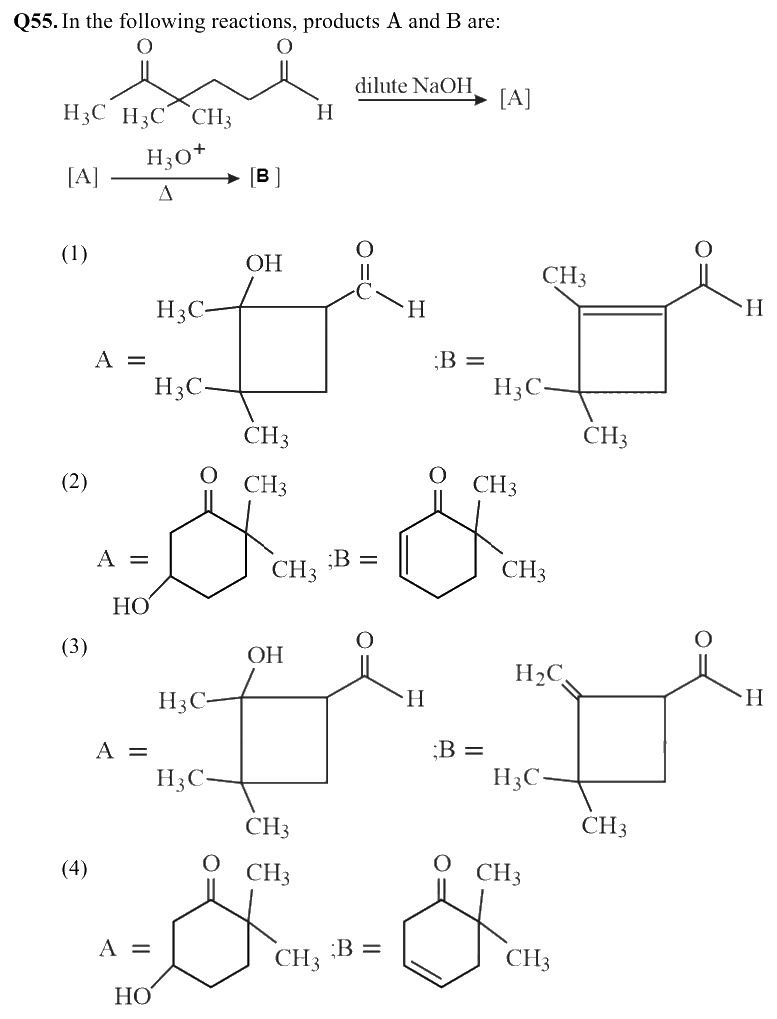
- (1)
see figure A = four-membered ring with OH, two $\mathrm{H_3C}$ and $\mathrm{CH_3}$ groups and a CHO; B = four-membered ring with a ring C=C bearing $\mathrm{CH_3}$ and a CHO
- (2)
see figure A = six-membered ring with C=O, $\mathrm{CH_3}$, $\mathrm{CH_3}$ and HO; B = six-membered ring with C=O, $\mathrm{CH_3}$, $\mathrm{CH_3}$ and a ring C=C
- (3)
see figure A = four-membered ring with OH, two $\mathrm{H_3C}$ and $\mathrm{CH_3}$ groups and a CHO; B = four-membered ring with an exocyclic $\mathrm{H_2C{=}}$ and a CHO
- (4)
see figure A = six-membered ring with C=O, $\mathrm{CH_3}$, $\mathrm{CH_3}$ and HO; B = six-membered ring with C=O, $\mathrm{CH_3}$, $\mathrm{CH_3}$ and a ring C=C
Show answer
Option (2) is correct.
Key from source paper