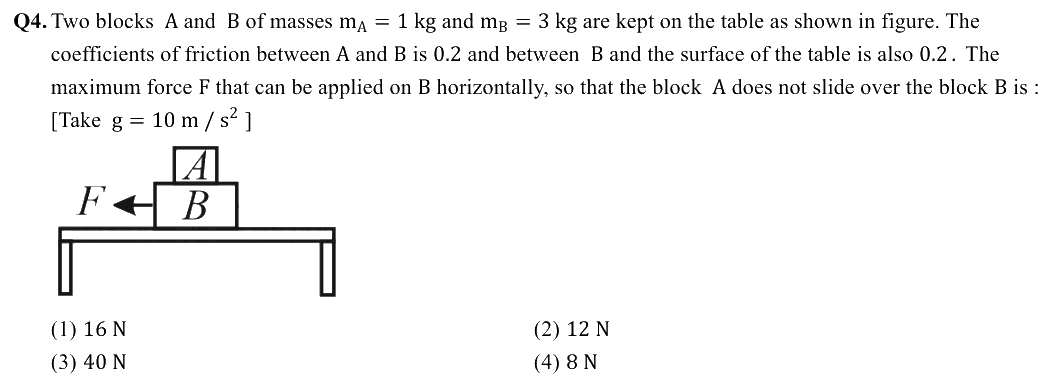
Two blocks A and B of masses $m_A = 1\ \mathrm{kg}$ and $m_B = 3\ \mathrm{kg}$ are kept on the table as shown in figure. The coefficients of friction between A and B is 0.2 and between B and the surface of the table is also 0.2. The maximum force F that can be applied on B horizontally, so that the block A does not slide over the block B is :
[Take $g = 10\ \mathrm{m/s^{2}}$]
(see the figure above)
- (1)
$16\ \mathrm{N}$
- (2)
$12\ \mathrm{N}$
- (3)
$40\ \mathrm{N}$
- (4)
$8\ \mathrm{N}$
Show answer
Option (1) is correct.
Key from source paper