Three isomers A, B and C (mol. formula $C_8H_{11}N$ ) give the following results:
$\mathrm{A\ and\ C} \xrightarrow{\mathrm{Dianotization}} \mathrm{P} + \mathrm{Q} \xrightarrow[\mathrm{(ii)\ acidation(KMnO_4+H^+)}]{\mathrm{(i)\ Hydrolyds}} \mathrm{R\ (product\ of\ A)} + \mathrm{S\ (product\ of\ C)}$
R has lower boiling point than S
$\mathrm{B} \xrightarrow{\mathrm{C_6H_5\ SO_2\ Cl}}$ alkali-insoluble product
A, B and C, respectively are:
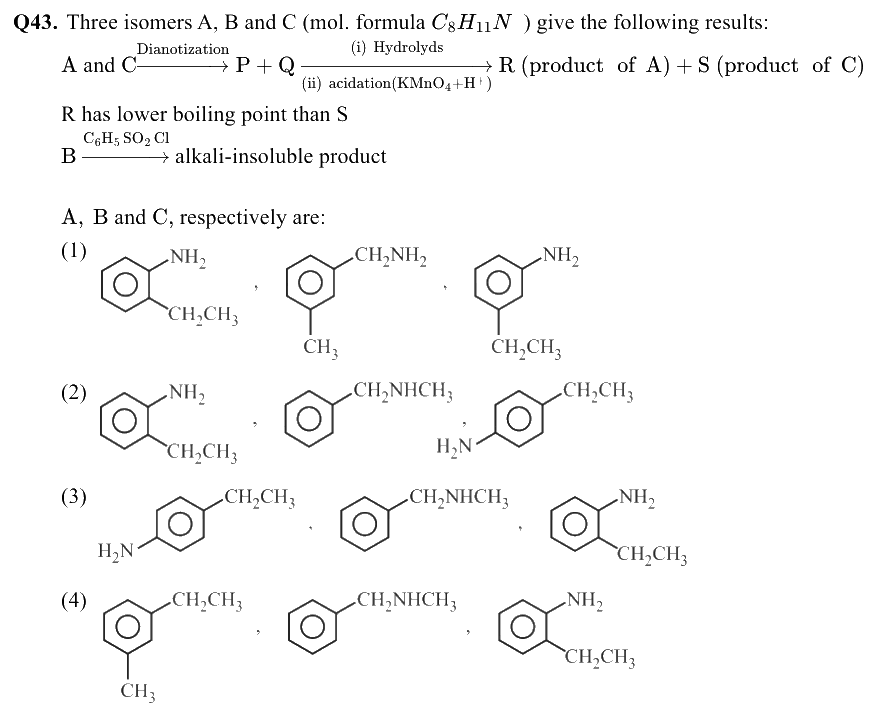
- (1)
see figure A: ring with NH2 and CH2CH3 on adjacent carbons; B: ring with CH2NH2 and CH3 (meta); C: ring with NH2 and CH2CH3 (para)
- (2)
see figure A: ring with NH2 and CH2CH3 on adjacent carbons; B: ring with CH2NHCH3; C: ring with CH2CH3 and H2N (para)
- (3)
see figure A: ring with CH2CH3 and H2N (para); B: ring with CH2NHCH3; C: ring with NH2 and CH2CH3 on adjacent carbons
- (4)
see figure A: ring with CH2CH3 and CH3 (meta), no NH2 drawn; B: ring with CH2NHCH3; C: ring with NH2 and CH2CH3 on adjacent carbons
Show answer
Option (2) is correct.
Key from source paper