Reaction of Grignard reagent, $\mathrm{C_2H_5\,MgBr}$ with $\mathrm{C_8H_8O}$ followed by hydrolysis gives compound A, which reacts instantly with Lucas reagent to give compound $\mathrm{B(C_{10}H_{13}\,Cl)}$.
The Compound B is:
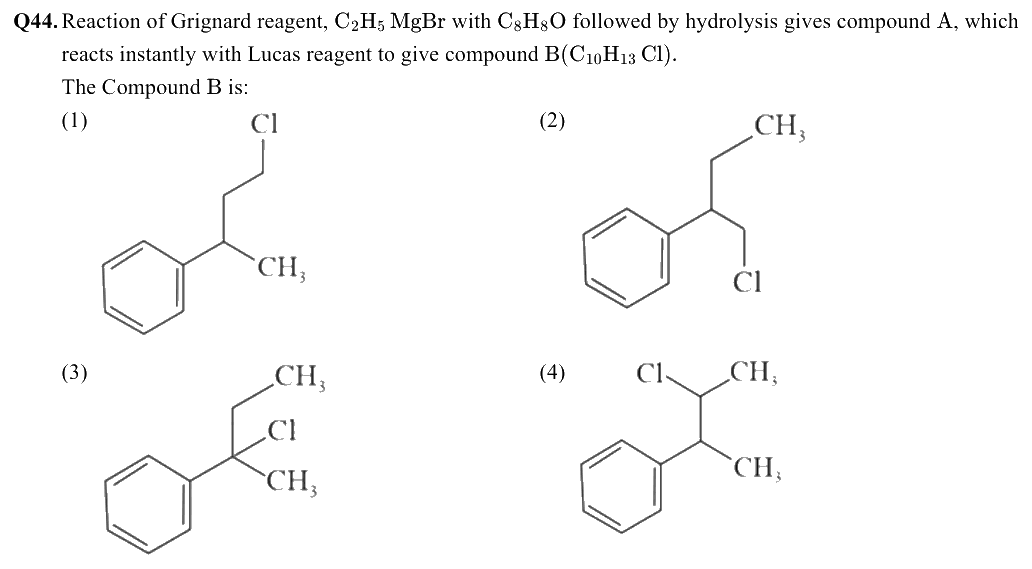
- (1)
see figure Benzene ring bonded to a CH carbon that bears a CH3 group (below) and a chain of two CH2 groups ending in Cl (Ph-CH(CH3)-CH2-CH2-Cl).
- (2)
see figure Benzene ring bonded to a CH carbon that carries an ethyl group (going up, ending in CH3) and a CH2-Cl group (going down) (Ph-CH(CH2CH3)-CH2Cl).
- (3)
see figure Benzene ring bonded to a carbon bearing Cl, a CH3 group (below) and an ethyl chain going up-right, ending in CH3 (Ph-C(Cl)(CH3)-CH2CH3).
- (4)
see figure Benzene ring bonded to a CH carbon that bears a CH3 group (below) and, on the next carbon, Cl (up-left) and CH3 (up-right) (Ph-CH(CH3)-CH(Cl)-CH3).
Show answer
Option (3) is correct.
Key from source paper