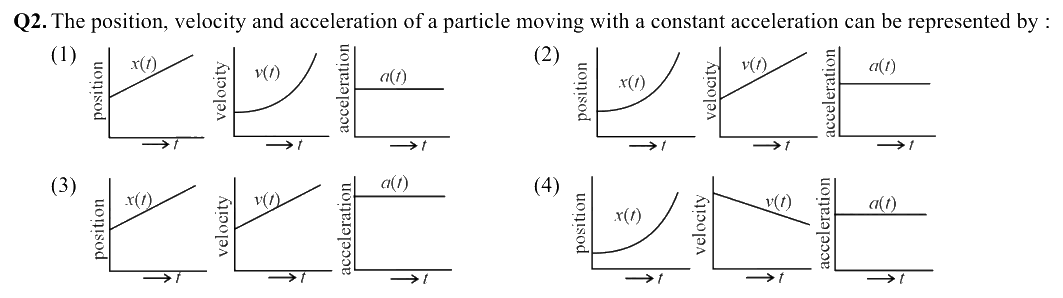
The position, velocity and acceleration of a particle moving with a constant acceleration can be represented by :
- (1)
see figure Three small graphs against t: position x(t) a straight rising line with a positive intercept; velocity v(t) a curve rising upward (convex, increasing slope) from a positive intercept; acceleration a(t) a horizontal line above the axis.
- (2)
see figure Three small graphs against t: position x(t) a curve rising upward (convex, increasing slope) from a positive intercept; velocity v(t) a straight rising line from a positive intercept; acceleration a(t) a horizontal line above the axis.
- (3)
see figure Three small graphs against t: position x(t) a straight rising line with a positive intercept; velocity v(t) a straight rising line with a positive intercept; acceleration a(t) a horizontal line above the axis.
- (4)
see figure Three small graphs against t: position x(t) a curve rising upward (convex, increasing slope) starting flat from a positive value; velocity v(t) a straight falling line; acceleration a(t) a horizontal line above the axis.
Show answer
Option (2) is correct.
Key from source paper