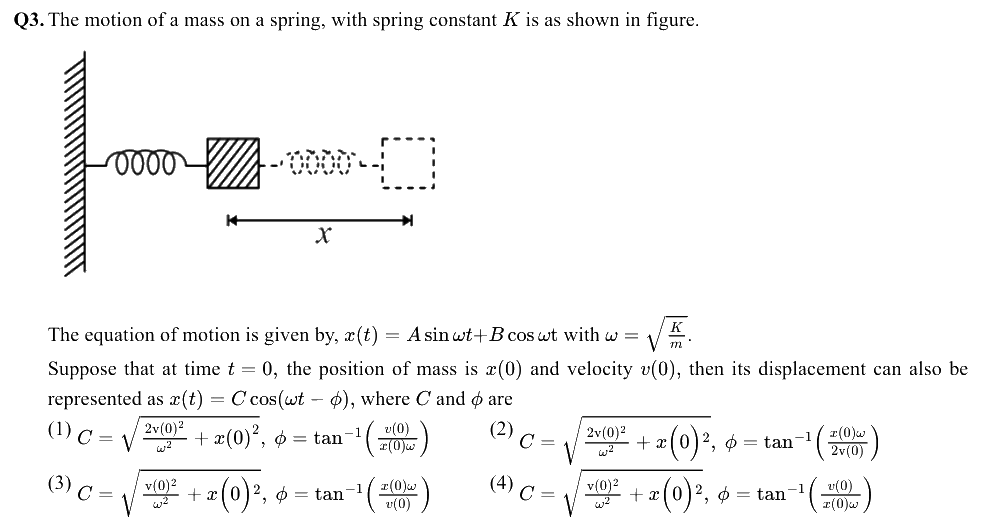
The motion of a mass on a spring, with spring constant $K$ is as shown in figure.
(see the figure above)
The equation of motion is given by, $x(t) = A\sin\omega t + B\cos\omega t$ with $\omega = \sqrt{\frac{K}{m}}$.
Suppose that at time $t = 0$, the position of mass is $x(0)$ and velocity $v(0)$, then its displacement can also be represented as $x(t) = C\cos(\omega t - \phi)$, where $C$ and $\phi$ are
- (1)
$C = \sqrt{\frac{2v(0)^2}{\omega^2} + x(0)^2}$, $\phi = \tan^{-1}\left(\frac{v(0)}{x(0)\omega}\right)$
- (2)
$C = \sqrt{\frac{2v(0)^2}{\omega^2} + x(0)^2}$, $\phi = \tan^{-1}\left(\frac{x(0)\omega}{2v(0)}\right)$
- (3)
$C = \sqrt{\frac{v(0)^2}{\omega^2} + x(0)^2}$, $\phi = \tan^{-1}\left(\frac{x(0)\omega}{v(0)}\right)$
- (4)
$C = \sqrt{\frac{v(0)^2}{\omega^2} + x(0)^2}$, $\phi = \tan^{-1}\left(\frac{v(0)}{x(0)\omega}\right)$
Show answer
Option (4) is correct.
Key from source paper