JEE Main 2021 (31 Aug Shift 1) Physics: Nuclei

Multiple choice, one correct option Memory based Nuclei

A sample of a radioactive nucleus $A$ disintegrates to another radioactive nucleus $B$, which in turn disintegrates to some other stable nucleus $C$. Plot of a graph showing the variation of number of atoms of nucleus $B$ vesus time is : (Assume that at $t = 0$, there are no $B$ atoms in the sample)
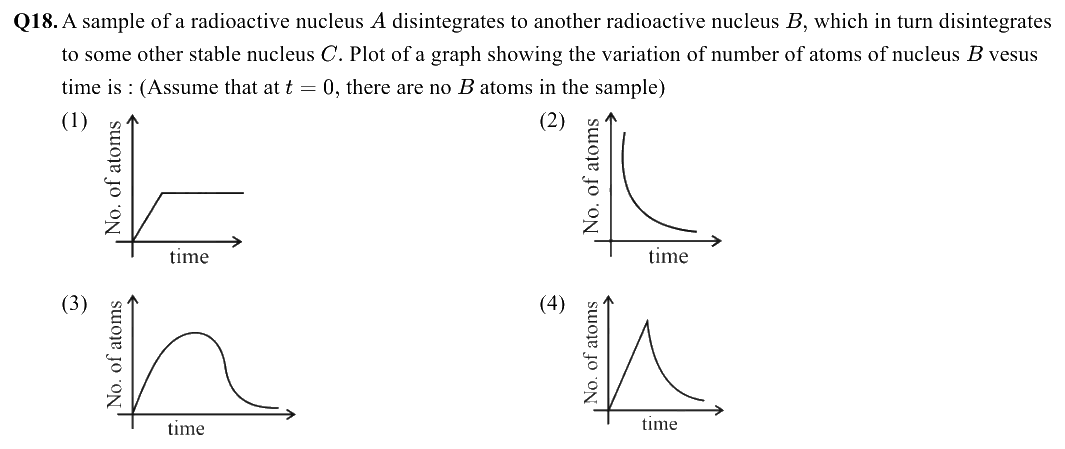
The question and its figure as printed in JEE Main 2021 31 Aug Shift 1. Option 1: No. of atoms against time; a straight line rising from the origin, then a horizontal flat line. Option 2: No. of atoms against time; a curve starting high on the vertical axis and falling steeply, then more slowly towards the time axis (decay curve). Option 3: No. of atoms against time; a curve rising from the origin to a rounded maximum, then falling with a long tail towards the time axis. Option 4: No. of atoms against time; a straight line rising from the origin to a sharp peak, then a curve falling towards the time axis.
The question as printed in the paper.
  1. (1)

    see figure No. of atoms against time; a straight line rising from the origin, then a horizontal flat line.

  2. (2)

    see figure No. of atoms against time; a curve starting high on the vertical axis and falling steeply, then more slowly towards the time axis (decay curve).

  3. (3)

    see figure No. of atoms against time; a curve rising from the origin to a rounded maximum, then falling with a long tail towards the time axis.

  4. (4)

    see figure No. of atoms against time; a straight line rising from the origin to a sharp peak, then a curve falling towards the time axis.

Show answer

Option (3) is correct.

Key from source paper

See the step-by-step solution in EdLoop

The worked solution is in the EdLoop app, free on Android, with every other Nuclei question from 2002 to 2026.

Physics Nuclei question from JEE Main 2021 (31 Aug Shift 1) (JEE Main exam). Memory-based papers are reconstructed from candidates' memory by coaching institutes.

All JEE Main Nuclei PYQs (164 questions)