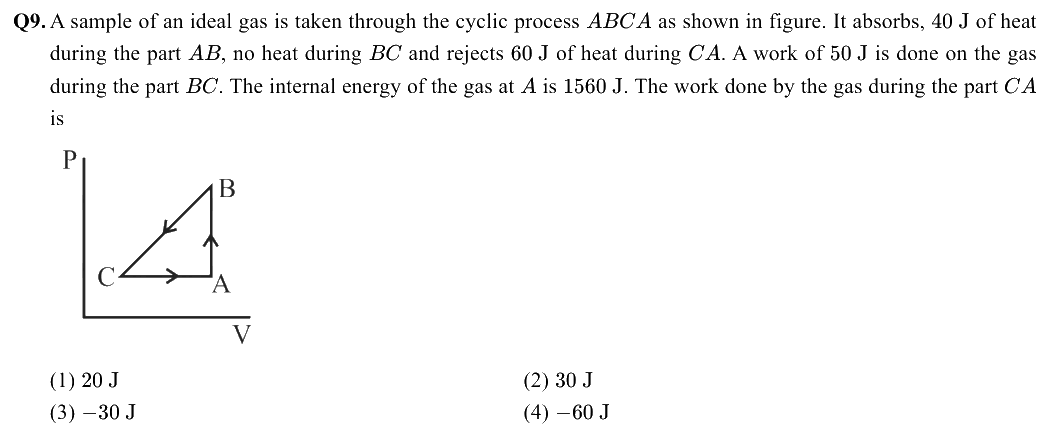
A sample of an ideal gas is taken through the cyclic process $ABCA$ as shown in figure. It absorbs, $40\ \mathrm{J}$ of heat during the part $AB$, no heat during $BC$ and rejects $60\ \mathrm{J}$ of heat during $CA$. A work of $50\ \mathrm{J}$ is done on the gas during the part $BC$. The internal energy of the gas at $A$ is $1560\ \mathrm{J}$. The work done by the gas during the part $CA$ is
(see the figure above)
- (1)
$20\ \mathrm{J}$
- (2)
$30\ \mathrm{J}$
- (3)
$-30\ \mathrm{J}$
- (4)
$-60\ \mathrm{J}$
Show answer
Option (2) is correct.
Key from source paper