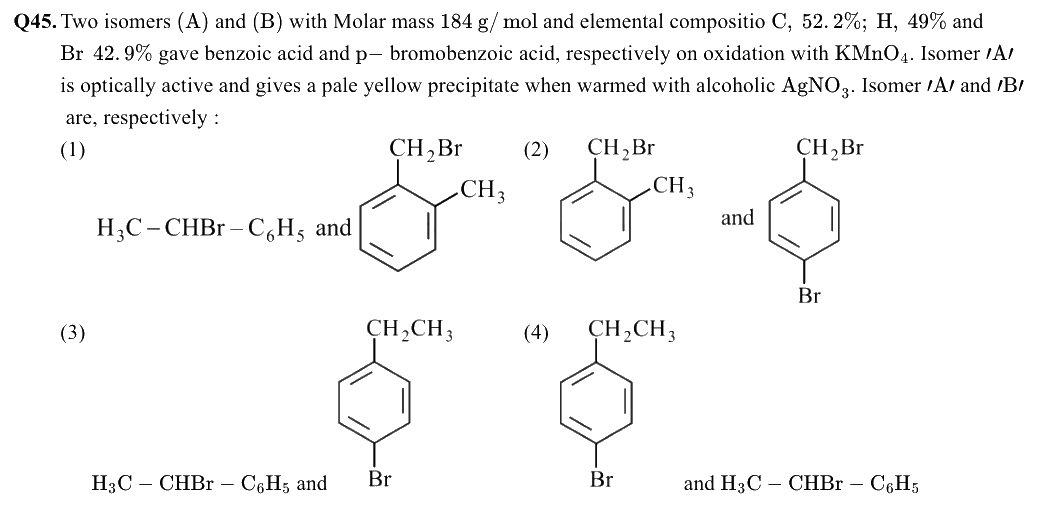
Two isomers (A) and (B) with Molar mass $184\ \mathrm{g/\ mol}$ and elemental compositio C, $52.2\%$; H, $49\%$ and Br $42.9\%$ gave benzoic acid and p$-$ bromobenzoic acid, respectively on oxidation with $\mathrm{KMnO_4}$. Isomer 'A' is optically active and gives a pale yellow precipitate when warmed with alcoholic $\mathrm{AgNO_3}$. Isomer 'A' and 'B' are, respectively :
- (1)
see figure A: $\mathrm{H_3C-CHBr-C_6H_5}$; B: a benzene ring with $\mathrm{CH_2Br}$ and $\mathrm{CH_3}$ on adjacent (ortho) carbons.
- (2)
see figure A: a benzene ring with $\mathrm{CH_2Br}$ and $\mathrm{CH_3}$ on adjacent (ortho) carbons; B: a benzene ring with $\mathrm{CH_2Br}$ at one position and Br para to it.
- (3)
see figure A: $\mathrm{H_3C-CHBr-C_6H_5}$; B: a benzene ring with $\mathrm{CH_2CH_3}$ at one position and Br para to it.
- (4)
see figure A: a benzene ring with $\mathrm{CH_2CH_3}$ at one position and Br para to it; B: $\mathrm{H_3C-CHBr-C_6H_5}$.
Show answer
Option (3) is correct.
Key from source paper