Let $\sigma$ be the uniform surface charge density of two infinite thin plane sheets shown in figure. Then the electric fields in three different region $E_I$ , $E_{II}$ and $E_{III}$
(see the figure above)
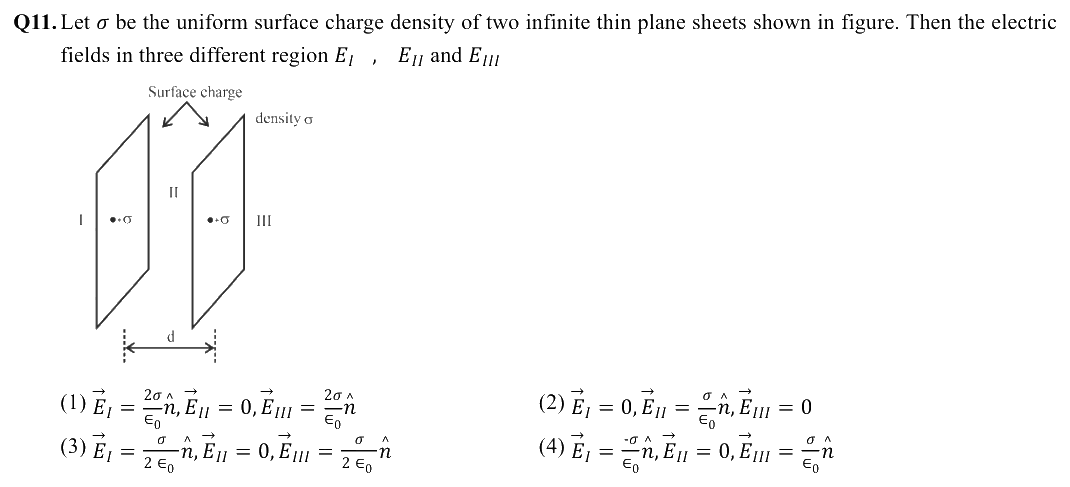
- (1)
$\vec{E}_I = \dfrac{2\sigma}{\epsilon_0}\hat{n}, \vec{E}_{II} = 0, \vec{E}_{III} = \dfrac{2\sigma}{\epsilon_0}\hat{n}$
- (2)
$\vec{E}_I = 0, \vec{E}_{II} = \dfrac{\sigma}{\epsilon_0}\hat{n}, \vec{E}_{III} = 0$
- (3)
$\vec{E}_I = \dfrac{\sigma}{2\epsilon_0}\hat{n}, \vec{E}_{II} = 0, \vec{E}_{III} = \dfrac{\sigma}{2\epsilon_0}\hat{n}$
- (4)
$\vec{E}_I = \dfrac{-\sigma}{\epsilon_0}\hat{n}, \vec{E}_{II} = 0, \vec{E}_{III} = \dfrac{\sigma}{\epsilon_0}\hat{n}$
Show answer
Option (4) is correct.
Key from source paper