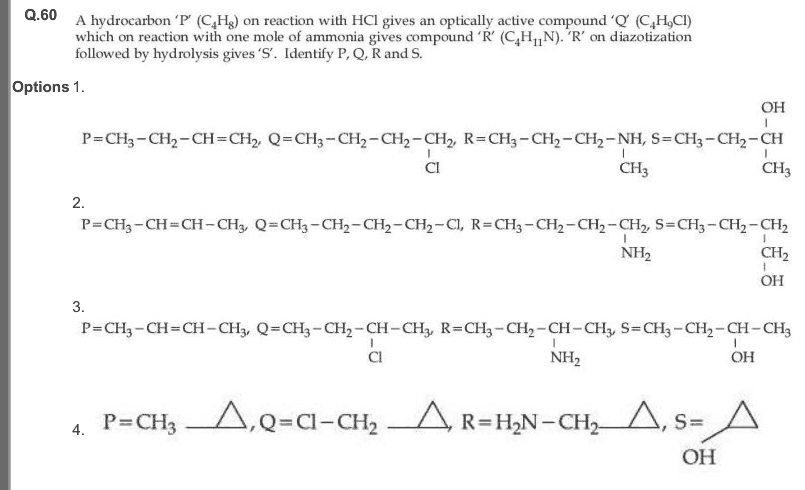
A hydrocarbon 'P' ($\mathrm{C_4H_8}$) on reaction with HCl gives an optically active compound 'Q' ($\mathrm{C_4H_9Cl}$) which on reaction with one mole of ammonia gives compound 'R' ($\mathrm{C_4H_{11}N}$). 'R' on diazotization followed by hydrolysis gives 'S'. Identify P, Q, R and S.
- (1)
see figure P=CH3-CH2-CH=CH2, Q=CH3-CH2-CH2-CH2 with Cl hanging below the last carbon, R=CH3-CH2-CH2-NH with CH3 hanging below the NH, S=CH3-CH2-CH with OH above the last carbon and CH3 below it (printed as condensed formulas with groups above and below the chain).
- (2)
see figure P=CH3-CH=CH-CH3, Q=CH3-CH2-CH2-CH2-Cl, R=CH3-CH2-CH2-CH2 with NH2 hanging below the last carbon, S=CH3-CH2-CH2 with CH2 hanging below the last carbon and OH below that.
- (3)
see figure P=CH3-CH=CH-CH3, Q=CH3-CH2-CH-CH3 with Cl below the CH, R=CH3-CH2-CH-CH3 with NH2 below the CH, S=CH3-CH2-CH-CH3 with OH below the CH.
- (4)
see figure P = CH3 attached to a triangle (three-membered ring), Q = Cl-CH2 attached to a triangle, R = H2N-CH2 attached to a triangle, S = a triangle with OH below it.
Show answer
Option (3) is correct.
Official NTA final key