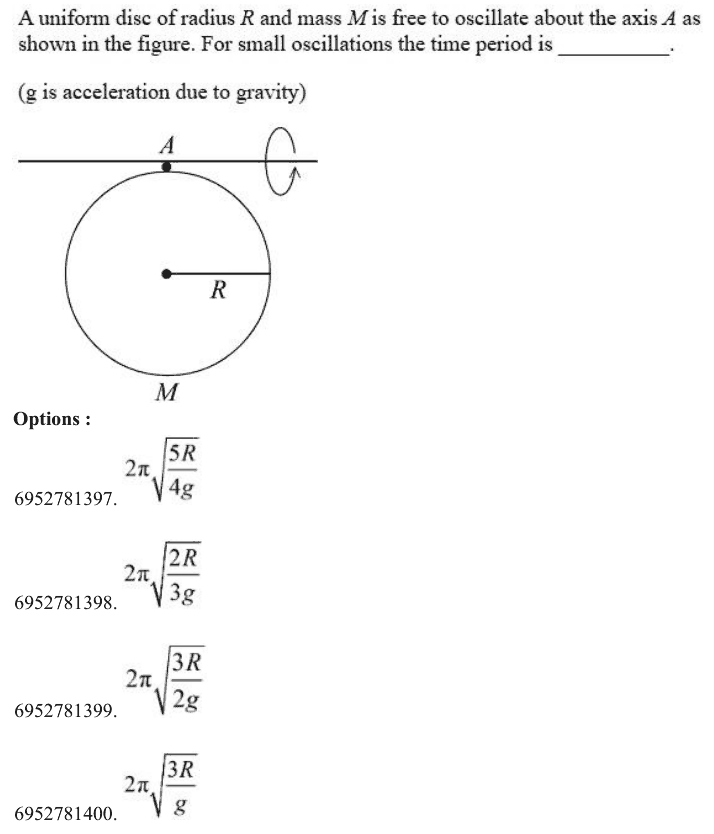
A uniform disc of radius $R$ and mass $M$ is free to oscillate about the axis $A$ as shown in the figure. For small oscillations the time period is ________.
($g$ is acceleration due to gravity)
(see the figure above)
- (1)
$2\pi\sqrt{\frac{5R}{4g}}$
- (2)
$2\pi\sqrt{\frac{2R}{3g}}$
- (3)
$2\pi\sqrt{\frac{3R}{2g}}$
- (4)
$2\pi\sqrt{\frac{3R}{g}}$
Show answer
Option (1) is correct.
Official NTA final key