An alkene (X) on ozonolysis followed by reduction gives following products.
(see the figure above)
The alkene (X) is:
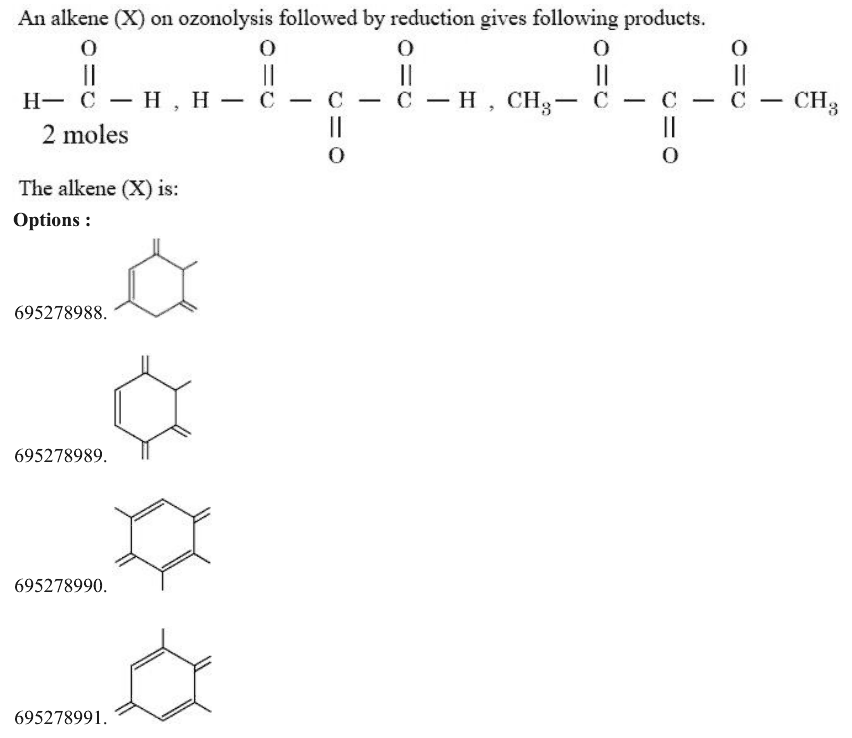
- (1)
see figure six-membered ring skeleton: top vertex with an exocyclic double bond pointing up; upper-right vertex with a short single-bond stub (methyl) pointing right; lower-right vertex with an exocyclic double bond pointing lower-right; bottom vertex plain (CH2); lower-left vertex with a short stub pointing left (methyl) and a ring C=C double bond between the lower-left and upper-left vertices.
- (2)
see figure six-membered ring skeleton: top vertex with an exocyclic double bond pointing up; upper-right vertex with a short stub pointing right; lower-right vertex with an exocyclic double bond pointing lower-right; bottom vertex with an exocyclic double bond pointing down; ring C=C double bond between the upper-left and lower-left vertices.
- (3)
see figure six-membered ring skeleton: upper-left vertex with a short stub (methyl) pointing up-left and a ring C=C double bond to the top vertex; upper-right vertex with an exocyclic double bond pointing up-right; lower-right vertex with a stub pointing right and a ring C=C double bond to the bottom vertex; bottom vertex with a stub pointing down; lower-left vertex with an exocyclic double bond pointing lower-left.
- (4)
see figure six-membered ring skeleton: top vertex with a stub pointing up and a ring C=C double bond to the upper-left vertex; upper-right vertex with an exocyclic double bond pointing up-right; lower-right vertex with a stub pointing right and a ring C=C double bond to the bottom vertex; lower-left vertex with an exocyclic double bond pointing lower-left.
Show answer
Option (4) is correct.
Official NTA final key