AIEEE 2006 Physics: Dual Nature of Matter & Radiation

Multiple choice, one correct option Memory based Dual Nature of Matter & Radiation

The anode voltage of a photocell is kept fixed. The wavelength $\lambda$ of the light falling on the cathode is gradually changed. The plate current I of the photocell varies as follows :

(see the figure above)
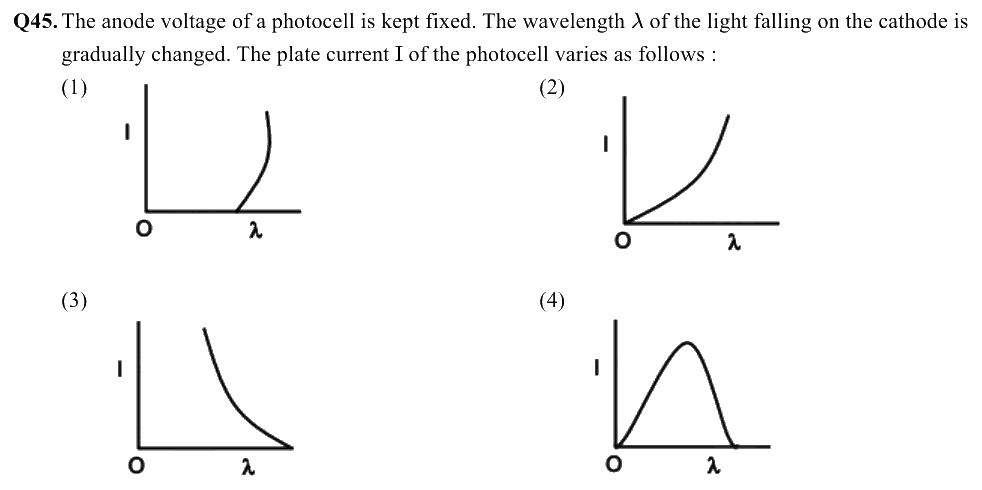
The question and its figure as printed in AIEEE 2006. Option 1: I against λ graph: current is zero (along the axis) from O up to a certain wavelength, then rises from the axis there, climbing upward and curving back slightly to the left near the top. Option 2: I against λ graph: curve rising from the origin O, convex upward (getting steeper with increasing λ). Option 3: I against λ graph: decreasing curve that starts high at a small non-zero λ (not at the I axis) and falls, convex, to meet the λ axis at the far right. Option 4: I against λ graph: curve rising from the origin O to a rounded maximum and then falling back to the λ axis at a finite wavelength.
The question as printed in the paper.
  1. (1)

    see figure I against $\lambda$ graph: current is zero (along the axis) from O up to a certain wavelength, then rises from the axis there, climbing upward and curving back slightly to the left near the top.

  2. (2)

    see figure I against $\lambda$ graph: curve rising from the origin O, convex upward (getting steeper with increasing $\lambda$).

  3. (3)

    see figure I against $\lambda$ graph: decreasing curve that starts high at a small non-zero $\lambda$ (not at the I axis) and falls, convex, to meet the $\lambda$ axis at the far right.

  4. (4)

    see figure I against $\lambda$ graph: curve rising from the origin O to a rounded maximum and then falling back to the $\lambda$ axis at a finite wavelength.

Show answer

Option (3) is correct.

Key from source paper

See the step-by-step solution in EdLoop

The worked solution is in the EdLoop app, free on Android, with every other Dual Nature of Matter & Radiation question from 2002 to 2026.

Physics Dual Nature of Matter & Radiation question from AIEEE 2006 (AIEEE, now called JEE Main). Memory-based papers are reconstructed from candidates' memory by coaching institutes.

All JEE Main Dual Nature of Matter & Radiation PYQs (208 questions)