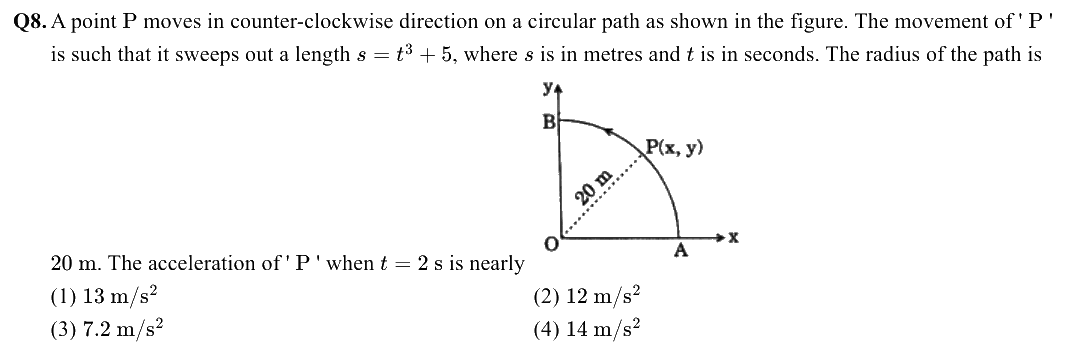
A point P moves in counter-clockwise direction on a circular path as shown in the figure. The movement of ' P ' is such that it sweeps out a length $s = t^3 + 5$, where s is in metres and t is in seconds. The radius of the path is 20 m. The acceleration of ' P ' when $t = 2$ s is nearly
(see the figure above)
- (1)
$13\ \mathrm{m/s^2}$
- (2)
$12\ \mathrm{m/s^2}$
- (3)
$7.2\ \mathrm{m/s^2}$
- (4)
$14\ \mathrm{m/s^2}$
Show answer
Option (4) is correct.
Key from source paper